
Hearing Aid Marketing Across Every Location
Hearing aid marketing for a chain with several locations works as one plan per location: the booked hearing test is the result, budget follows open test slots, every lead gets a same-day call and each location is judged on booked tests per week.
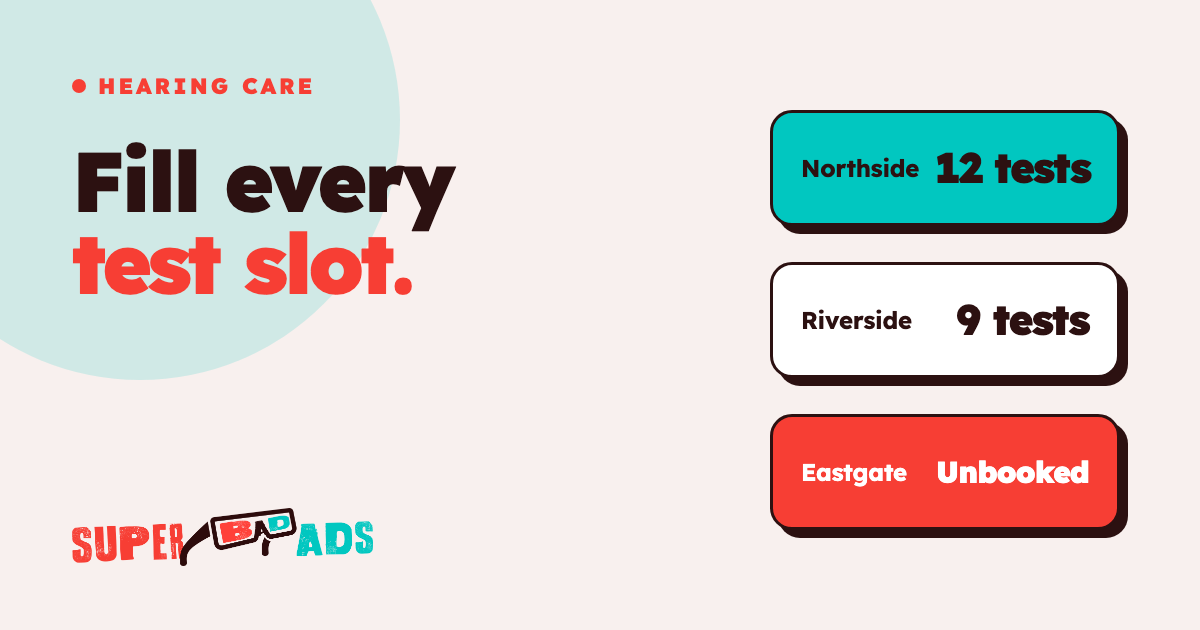
Hearing aid marketing for a chain with several locations works best as one plan per location, built around a single result: the booked hearing test. Budget should follow each location's open test slots, local search and paid search should catch people who are already looking, paid social and direct mail should reach the adult children and spouses who often start the conversation, and every location should be judged on booked and completed tests per week, counted in your scheduling system.
Most advice on this topic is written for a single audiology practice and never says which location needs which tactic. When one location is booked out for hearing evaluations and another has open slots every morning, the same campaign wastes money at the first and falls short at the second. This guide is for the owner-operator of a hearing aid and audiology chain who wants one plan the whole company can run and one weekly report the owners can check.
What should hearing aid marketing count as a result?
Hearing aid marketing should count booked hearing tests as the result, then track how many of those tests are completed and how many lead to a fitting. Clicks, calls and form fills are steps along the way, and an agency that reports them as the outcome is asking you to trust a number your front desk can't see.
The booked test is the right unit because, at that point, one of your potential patients becomes a patient with a time, a location and one of your hearing care professionals. Your scheduling system already records that number, so the owners can check it without any new software. When the ad platforms report more conversions than your books show, believe the books.
The National Institute on Deafness and Other Communication Disorders states that "about 28.8 million U.S. adults could benefit from using hearing aids." The job of your marketing is to turn some of that need near each location into booked visits that your audiologists and hearing instrument specialists can see.
How should a hearing care chain split its budget across locations?
A hearing care chain should split its budget by open test slots at each location, not evenly. An even split pays for leads at locations that can't see them for weeks and starves the locations with empty calendars. Write the rule down for each type of location before any campaign goes live.
| Location situation | Open test slots | Budget rule | Message focus |
|---|---|---|---|
| Booked out for weeks | Few or none | Lowest priority for new spend | Reviews and referrals; hold paid search to brand terms |
| Steady, with midweek gaps | Some each week | Fund the weak days | Local search and paid search for people looking now |
| Open calendar or a new provider | Many | Funded first | Paid search, paid social to family members, direct mail near the store |
| New location | All of them | Launch budget, then ramp | Neighborhood awareness and a clear first-visit offer |
Review the split every month, because schedules and competitors change. A new store needs its own plan before the doors open, and our guide on how to market a new location opening covers that timeline.
Which channels should a hearing aid chain use for each location?
A hearing aid chain should give each channel one job, so the owners can see which one is earning its budget. Most of the useful hearing aid marketing ideas fit into four channels, and every location needs the first two before it spends on the others.
Google Business Profile and reviews: each location's profile is often the first thing a shopper sees in search engine results after searching for a hearing test nearby, so it carries most of a store's online presence. Keep hours, services and providers accurate, and ask satisfied existing patients for a review at the end of each visit, because recent reviews build trust before anyone calls. Our guide to review generation explains how to make that ask a weekly habit at every location without breaking Google's rules.
Paid search: hearing aid advertising on Google catches people who are already searching for a test, a fitting or a repair near a store.
Paid social: Meta ads reach the adult children and spouses who often notice the problem first and push for the appointment. Write creative that speaks to them as well as to the person with the hearing loss, and aim it at the neighborhoods around locations with open slots.
Direct mail: many hearing clinics still send mail to older households near each store, so the chain should give each mailing its own phone number or booking link and judge it on booked tests like any other channel.
How have OTC hearing aids changed hearing aid advertising?
Over-the-counter hearing aids changed hearing aid advertising by giving shoppers a cheaper choice they can buy without a visit, so a chain's message has to explain what the visit adds. The FDA states that OTC hearing aids "are intended for use by people 18 years of age and older to help with perceived mild to moderate hearing loss," and that anyone who suspects "a more severe or profound hearing loss" should "consult with a licensed hearing health care professional."
That's the opening for audiology marketing in a hearing healthcare chain, and blog posts that explain the first visit can support it in search. Competing on device price against large national retailers that sell hearing devices off the shelf is a race most chains lose, so the stronger message sells the appointment: a hearing evaluation, a professional fitting, adjustments over the following weeks and a local team the patient can return to over the long term. Keep claims about outcomes out of your ads, let a licensed healthcare professional make clinical recommendations in the room, and make the first visit easy to book.
What rules apply to health ads for hearing care?
Health ads for hearing care must respect the ad platforms' limits on targeting people by health condition, and those limits apply to every campaign you run. Google's policy on health in personalized advertising states that "Content related to Health is a sensitive interest category" and lists "Physical or mental health conditions, including diseases, sexual health, and chronic health conditions" among its examples.
In practice, that means you aim campaigns at places, search terms and interest in the service, never at a person's presumed hearing loss. It also means patient lists, test results and appointment records stay in your own systems. We count booked hearing tests in your scheduling system and report them next to spend, without sending any patient data to Meta, Google or any other ad platform. State rules for hearing aid dispensers vary, so check with your compliance lead or counsel before a new offer or testimonial goes live.
How do you keep leads from dying before the hearing test?
You keep leads from dying by calling every new inquiry back the same day and by tracking, per location, how many inquiries become booked tests. Many hearing care leads are hesitant, and a person who waited years to ask about their hearing can lose their nerve if nobody answers that day.
Decide who answers each lead, the front desk at each store or a central team, and record that rule in the playbook every location follows. Our guide to speed to lead covers how to measure response time per location and how to tell whether a weak week came from the ads or from the follow-up. If inquiries rise at a location while booked tests stay flat, the fix is in the follow-up, not the budget.
Where to start
Super Bad Ads is the paid media partner for multi-location operators, including hearing aid and audiology chains. We run Meta and Google for every location and report booked hearing tests per location every week, counted in your scheduling system, not in the ad platform, so the numbers are stricter than the platforms' own reports. See how we work as a retail marketing agency for store chains with appointments and fittings, and as a paid media agency.
Marketing for hearing aid practices with several stores follows the same plan we use for other service-retail chains, which our post on retail marketing strategies lays out store by store. Outside hearing care, for a 30+ location grooming brand, cost per new client fell 34.3% against a static-only baseline. For your chain, start this week by writing each location's open test slots next to its spend and setting up one weekly scoreboard of booked and completed tests.
FAQ
What is the best hearing aid marketing strategy for a chain with several locations?
The best hearing aid marketing strategy for a chain with several locations is one plan per location built around booked hearing tests. Budget follows open test slots, local search and paid search catch people already looking, paid social reaches family members, and every location is judged weekly in the scheduling system.
How should a hearing aid chain split its advertising budget across locations?
A hearing aid chain should split its advertising budget by open test slots rather than evenly. Locations with empty calendars or a new provider are funded first, locations booked out for weeks get the least new spend, and the split is reviewed every month as schedules change.
Can a hearing aid business target ads to people with hearing loss?
A hearing aid business can't target ads to people based on a presumed health condition such as hearing loss, because Google treats health as a sensitive category in personalized advertising. Campaigns should target places, search terms and interest in the service, and patient data should stay out of ad platforms.
How do you measure hearing aid marketing results for each location?
You measure hearing aid marketing results for each location with a weekly scoreboard from the scheduling system: booked tests, completed tests, fittings and cost per booked test. These numbers are stricter than ad platform reports, and they show which location needs budget and which needs better follow-up.
One plan per location
Hearing aid marketing for a chain comes down to one plan per location, budget that follows open test slots, a same-day call for every lead and one weekly scoreboard of booked tests. For help running paid media for every location, with results counted in your scheduling system, Get Started.
Find out what your ad spend actually books.
We instrument the whole funnel — lead to booked to showed to revenue — and buy media against the number that matters. No calendar invites, no sales-call bait. Just the build.
Get Started →