
How to Market a Dental Practice, Step by Step
How to market a dental practice with several offices comes down to order: foundations at every office first, then paid search, then paid social, then one weekly scoreboard of new patients per office.
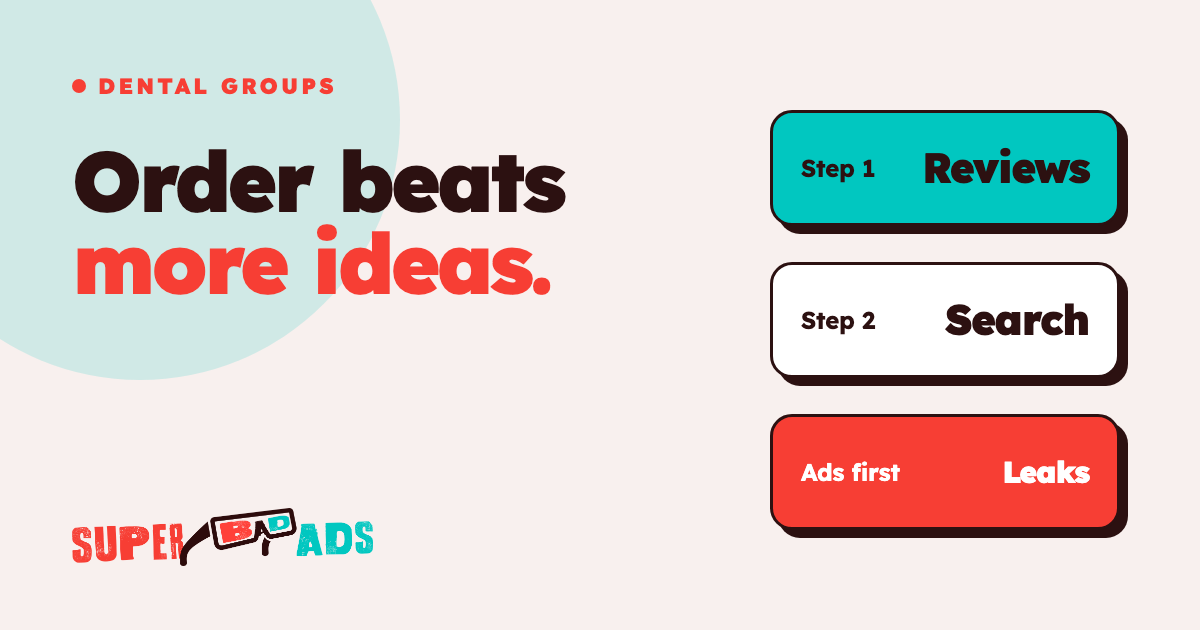
How to market a dental practice with several offices comes down to order, not to the length of your list of ideas. Start with the foundations at every office (a complete Google Business Profile with steady reviews, a booking path and a front desk that answer and follow up on every new-patient call, and new patients counted per office in your practice management system), then add paid search, then paid social, and run one weekly per-office scoreboard that decides where the next dollar goes.
Each step should start only when the step before it passes a clear test at that office. A group that buys ads before its phones are answered pays to send new patients into voicemail, and a group that can't count new patients per office can't tell which campaign filled which chairs. This guide on how to market a dental practice is for the owner-operator of a dental group with four to forty offices who runs marketing with a small central team and wants the sequence, office by office.
Why does the order of marketing moves matter for a dental group?
The order matters because each step depends on the one before it, and a group with many offices multiplies every gap in its digital marketing. Paid search sends calls to the front desk, so an office that misses calls turns ad spend into lost patients. Paid social warms nearby people who later search for a dentist, so an office with a thin profile and few reviews loses them at the moment they compare options.
Most owners don't lack ideas, and our list of dental marketing ideas covers the options in detail. The harder question in dental practice marketing is which move comes first at which office, and which conditions must hold before the next one starts, because an effective dental marketing strategy depends on the order of your marketing channels as much as on the channels themselves. Knowing how to market a dental practice in the right order separates a group that learns from its spend from one that buys a new tactic every quarter.
What should every office have in place before you spend on ads?
Every office needs three foundations before it receives a paid budget: a local profile that earns trust, a booking path that converts interest into appointments, and a count of new patients that the partners believe. These quiet basics of marketing a dental practice decide whether every later dollar of paid advertising pays off, and they also serve existing patients who look up an office before a recall visit.
Google Business Profile and reviews: local SEO, the office-level side of search engine optimization (SEO), starts here, and each office needs its own complete, accurate profile with correct hours, services, photos and a phone number that rings at that office. Google says that "local results are mainly based on relevance, distance, and popularity," and that "more reviews and positive ratings can help your business's local ranking." Steady patient reviews build trust with families comparing dental care nearby, so ask satisfied patients for a review as a routine habit at every office, and never mention treatment details when you reply to a review.
Booking path and front-desk follow-up: a new patient should be able to call and reach a person, book online in a few steps on a mobile friendly page, or receive a call back the same business day after a missed call or a web form. The American Dental Association advises practices to "make sure your front desk staff consistently ask first-time callers how they heard about your practice."
New patients counted per office: count a new patient as a first visit that took place, pull that number from your practice management system for each office every week, and agree on it with the partners before any campaign launches. We count booked appointments in your practice management system and report them next to spend. Check with your counsel or compliance lead on how your offices handle patient information in calls, forms and reviews.
What does the sequence look like across your offices?
The sequence has four steps, and each office moves through them at its own pace, so one office may be ready for paid social while a newly acquired office still fixes its phone coverage. The table below shows how to market a dental practice office by office, giving the partners and the central team one view of each step, its readiness test and its owner.
| Step | What it covers at each office | Ready for the next step when | Who owns it |
|---|---|---|---|
| 1. Foundations | Google Business Profile, reviews, booking path, front-desk follow-up, new-patient count | Calls are answered or returned the same day, and new patients are counted weekly in the practice management system | Office manager, with the central team |
| 2. Paid search | Search ads for nearby people looking for a dentist, aimed at offices with open chair time | Cost per new patient is steady and calls convert to booked visits | Central team or agency |
| 3. Paid social | Ads that reach nearby people before they search, with creative from your own offices | Paid social adds new patients at an acceptable cost per new patient | Central team or agency |
| 4. Weekly scoreboard | New patients per office, cost per new patient, calls answered, open chair time | Runs every week and decides where next week's budget goes | Owner-operator and partners |
A front-desk turnover, a new associate dentist or an acquisition can send an office back to step one, and the scoreboard is how you notice.
When should a dental group add paid search?
Add paid search at an office once it passes step one and has open chair time to fill. People who search for a dentist near them are ready to book, so paid search is usually the closest paid channel to a booked first visit, and it works best alongside a steady SEO strategy that keeps each office visible in organic results.
Build campaigns office by office in one shared account so offices don't bid against each other. Google explains that "Google Ads location targeting allows your ads to appear in the geographic locations that you select," which lets each office receive its own radius and budget. Each office's ads should point to its own landing page and phone number, so calls, forms and website traffic stay tied to the office that paid for them. Our guide to google ads for dentists covers the account structure, keywords and healthcare ad policy in detail.
When does paid social belong in the plan?
Paid social belongs in the plan once paid search is steady at an office and you want to reach nearby people before they start searching. Meta ads build familiarity, so your office is the name a family recognizes when it next needs a dentist. Social media marketing works best with creative filmed at your own offices with your own dentists and staff, because familiar faces read as more credible than stock images.
Its leads are less ready to book than search leads, so they depend on fast, friendly follow-up from the front desk. Set marketing budgets by each office's open chair time rather than splitting them evenly, and keep email marketing to existing patients separate from the paid budget so each line is judged on its own results. Our post on facebook ads for dentists covers creative, Meta's health advertising rules and the lead follow-up that turns a form into a visit.
How do you run the weekly per-office scoreboard?
For anyone working out how to market your dental practice group, the scoreboard is the step that ties the others together. Run it every week from your practice management system and your phone records, not from the ad platforms, and review it with the partners on a fixed day. Four numbers per office are enough to guide decisions about dental office marketing across the whole group:
- New patients per office per week: first visits counted in the practice management system.
- Cost per new patient: each office's paid media spend divided by its new patients.
- Calls answered or returned: the share of new-patient calls that reached a person the same business day.
- Open chair time: the number that decides which offices get more budget next week.
This scoreboard is stricter than the ad platforms' own reports, because it counts only patients who came in. When calls stay high but new patients fall, the fix is at the front desk; when calls fall while spend holds, the fix is in the ads. Our guide on how to get more dental patients walks through the new-patient path behind these numbers.
Where to start
Super Bad Ads is the paid media partner for multi-location operators, including dental groups. We run Google and Meta for every office and report booked new patients per office every week, counted in your practice management system, not in the ad platform, and our reporting is stricter than the platform numbers. See how we approach dental marketing services and how we work as a paid media agency.
We test cheap, representative creative from your own offices, and we let you switch safely, with an audit first and every account and pixel in your name. Outside dental, for a 30+ location grooming brand, cost per new client fell 34.3% against a static-only baseline. If you're deciding how to market a dental practice group this quarter, check every office against the step-one foundations and set up the weekly scoreboard before adding new spend.
FAQ
What is the first step in marketing a dental practice?
The first step in marketing a dental practice is fixing the foundations at every office: a complete Google Business Profile with steady reviews, a front desk that answers or returns every new-patient call the same day, and a weekly count of new patients per office from the practice management system.
How much should a dental group spend on marketing?
How much a dental group should spend on marketing depends on each office's open chair time and its cost per new patient, not on a fixed rule. Fund the offices with room in their schedules first, hold spend at offices that are booked out, and adjust the split each week from the scoreboard.
Should each dental office have its own Google Business Profile?
Each dental office should have its own Google Business Profile, because Google ranks local results by relevance, distance and popularity for each address. Every profile needs that office's hours, services, photos and a phone number that rings at that office, plus a steady flow of reviews from its own patients.
How do you know if dental practice marketing is working?
You know dental practice marketing is working when new patients per office rise in the practice management system at a cost per new patient the partners accept. Platform leads and clicks don't prove it; only first visits counted office by office, every week, tell you which channels and offices earn more budget.
Market every office in order
How to market a dental practice across several offices comes down to fixing the foundations first, adding paid search and then paid social office by office, and letting one weekly scoreboard of new patients per office decide the budget. For help running paid media for every office, with new patients counted in your practice management system, Get Started.
Find out what your ad spend actually books.
We instrument the whole funnel — lead to booked to showed to revenue — and buy media against the number that matters. No calendar invites, no sales-call bait. Just the build.
Get Started →