
Salon Marketing Strategies: One Plan for Each Salon
Salon marketing strategies for a brand with several salons work as one plan per salon: budget follows open chair time, paid media brings new clients, the front desk keeps them, and every salon is judged on new clients per salon per week.
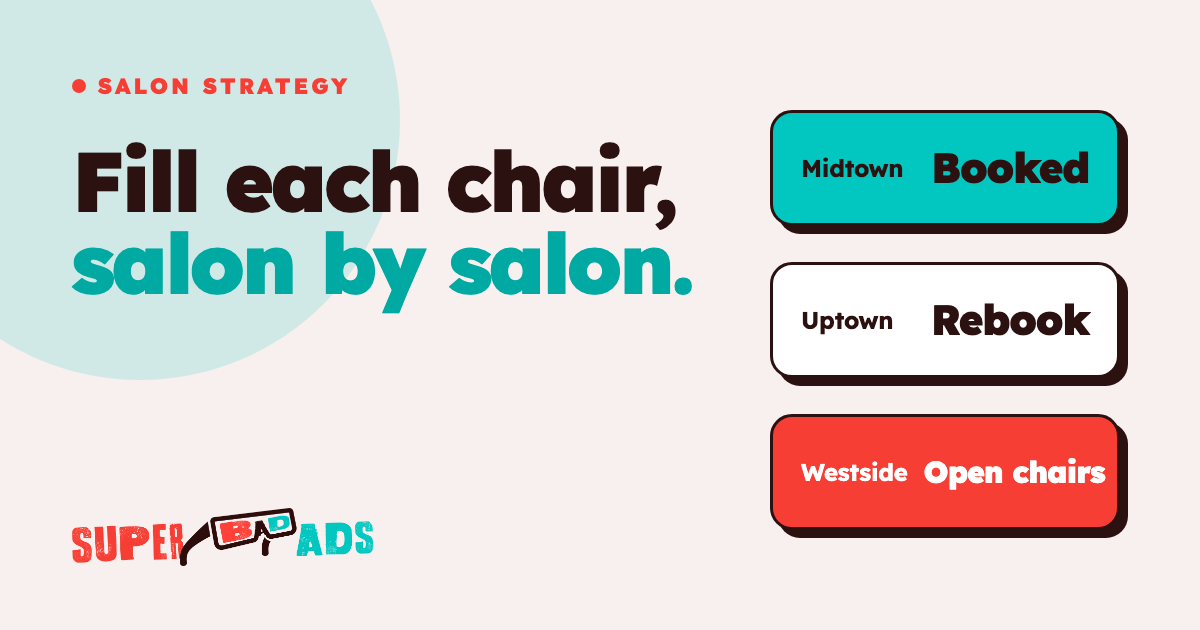
Salon marketing strategies for a brand with several salons work best as one plan per salon. Size each salon's plan by its open chair time and stylist capacity, use paid media to attract new clients and the front desk to keep them, keep the brand, offers and reporting central while the local details stay local, and judge every salon on new clients per salon per week from the booking system.
A list of tactics can't tell you which salon needs them. When one salon has a waitlist and another has empty chairs on Tuesday mornings, the same promotion at both wastes money at one and falls short at the other. This guide is for the salon owner and the business owners behind a salon brand who want a salon marketing plan that runs across every location and can be checked in one weekly report.
What should a salon marketing strategy decide for each salon?
A salon marketing strategy should decide four things for every salon: how much open chair time it has, how many new clients it needs, what budget it gets and how it rebooks clients. Write those four answers on one page before any campaign goes live. That page gives the owner, the marketing team and each salon manager the same plan.
| Salon | Open chair time | New-client goal | Budget rule | Rebooking rule |
|---|---|---|---|---|
| Salon with a waitlist | Little or none | Hold steady | Lowest priority for new spend | Rebook every client at checkout |
| Salon with steady books | Some gaps midweek | Fill the gaps | Funded for the weak days | Rebook every client at checkout |
| Salon with empty chairs | Large, or a new stylist | Grow the book | Funded first | Rebook every client at checkout; track it weekly |
| New salon | All chairs open | Build a base of regulars | Launch budget, then ramp | Book the second visit before the client leaves |
Ideas and tactics only help once they sit inside this plan. Our post on salon marketing ideas lists channels to choose from, our salon promotion ideas cover the offers, and this post covers how to decide which salon gets which one.
How do you split effort between new clients and returning clients?
Split the work by job: paid media brings new clients through the door, and the front desk and stylists keep them. Many owners worry that ads fill chairs with bargain hunters who don't come back. That happens when the same discount is used to win new clients and to bring regulars back, which trains the brand's best clients to wait for a deal.
New clients: paid social and Google Ads carry a special offer for first-time clients only, aimed at the neighborhood around each salon that has room in its books.
Returning clients: the strongest retention step is rebooking at checkout. Before the client leaves, the front desk or the stylist offers the next appointment, and that habit belongs to each salon rather than to the ads.
Regulars: don't run discounts to win back existing clients who already come in. Reminders, a stylist's personal note, a simple loyalty program and easy online booking do that work without cutting your price, and they keep the client base healthy between campaigns.
What should stay central, and what should stay local?
Keep the brand, the offers, the creative, the ad accounts and the reporting central, and keep the stylists, the hours, the listing details, the review habit and lead follow-up local. A central account also stops two of your salons from bidding against each other for the same search. Our guide to multi location marketing covers this split for every kind of operator.
Each salon's Google Business Profile is a local job with a large payoff, because it is where nearby clients compare hair salons before they book. Google explains that "when a customer searches for a business or place near their location, they'll find local results on Google Maps and Search." Google also notes that complete and accurate listings are more likely to appear in local results, and that "more reviews and positive ratings can help your business's local ranking."
Online reviews are worth asking for at every checkout, but you can't pay for them. Google's rules say you can't offer "free or discounted goods or services, in exchange for customers to post reviews," and that replies should "avoid using your response to offer deals or promotions."
Which channels should a salon brand use to attract new clients?
A salon brand with several locations usually needs four channels, and each one has a clear job. Paid social on Meta reaches people near each salon who aren't searching yet, which makes it the best channel for filling open chair time with new faces. Google Ads captures people who are already searching for salon services nearby, so it suits salons with gaps they need to fill this week. Local search, through each salon's Google Business Profile and its online reviews, supports every location at a low cost. Word of mouth and referrals from existing clients carry weight in the beauty industry, because a friend's recommendation arrives with trust already built, so the front desk should ask for them as consistently as it asks for reviews.
Every channel should be judged the same way. A channel earns more budget when it brings booked first-time clients at a salon with room for them, and it loses budget when it brings clicks, calls or messages that never turn into appointments.
How do you set a salon marketing budget by open chair time?
Set each salon's budget by its open chair time, not by an even split. An even split starves the salons with empty chairs and pays for clicks at salons that can't take another appointment. Spend on a fully booked salon also frustrates new clients who can't get a time that suits them, which is a poor first experience of the brand. Barber brands face the same chair math; see our list of barbershop marketing ideas.
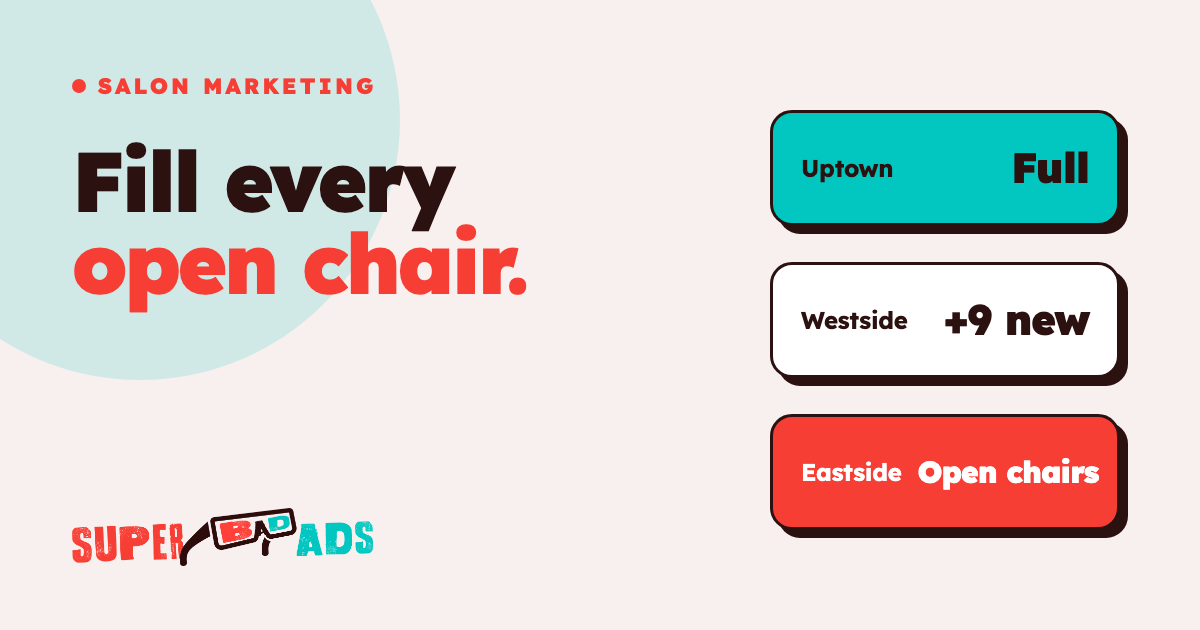
Fund the salons with room first. If one salon has a waitlist and another has open chairs every weekday morning, move the new-client budget to the salon with room until its books fill. When a stylist leaves or a new stylist starts, that salon's open chair time changes, so its budget should change too.
Base these decisions on the booking system, not on the ad platform. Ad platforms count conversions their own way, and they often count more than your books show. Our post on why your booking system and ad platform disagree explains why. Review open chair time and budget for every salon each month.
How should a new salon launch?
A new salon's marketing starts before the doors open. Build a pre-opening list from the neighborhood with local paid social and a sign-up page, then turn that list into booked appointments for opening week. After the opening, fund the ramp weeks until the stylists' books fill, and make sure the front desk calls back every new inquiry the same day. Our guide on how to market a new location opening covers the timeline in detail.
How do you track salon marketing strategies per salon?
Track salon marketing strategies with one weekly scoreboard per salon, pulled from your booking system, whether that's Zenoti, Booker or another platform. Four numbers are enough:
- New clients per salon per week: first-time clients counted in the booking system.
- Cost per new client: that salon's ad spend divided by its new clients.
- Rebooked share: the share of clients who leave with their next appointment booked.
- Open chair time: the number that decides where next week's budget goes.
This scoreboard is stricter than the ad platforms' own reports, because it only counts clients who actually booked. Review it every week with each salon manager. If rebooked share falls at one salon, the fix is at the front desk; if new clients fall while spend holds, the fix is in the ads.
What makes salon marketing strategies for multiple locations different?
With salon marketing strategies for multiple locations, the brand has to decide where each dollar goes, not just how to spend it. A single local business can run one offer and one calendar, but a group needs a rule for which salon gets the next ideal client. That rule is open chair time, checked every week in the booking system.
Groups also gain advantages that a single salon lacks. Creative made at one salon can be tested and reused at the others, a winning offer can roll out across every location, and one central report can show the board how every salon is doing. Clients feel the difference too, because the same brand promise, the same booking experience and the same standard of service meet them at every salon.
Where to start
Super Bad Ads is the paid media partner for multi-location operators, including salon brands. We run Meta and Google for every salon and report new clients per salon every week, counted in your booking system, not in the ad platform. See how we work as a salon marketing agency and as a paid media agency.
Our creative comes from your own chairs, made cheaply and tested as many small bets. Switching to us is low risk: we start with an audit, overlap with your current agency, and you own every account and pixel. Outside salons, for a 30+ location grooming brand, new customers rose 36.6% and cost per new client fell 34.3% against a static-only baseline. For your brand, start this week: write the one-page plan for every salon and set up the weekly scoreboard.
FAQ
What is the best marketing strategy for a salon with several locations?
The best marketing strategy for a salon brand with several locations is one plan per salon, sized by open chair time and stylist capacity. Paid media brings in new clients, the front desk rebooks them at checkout, and every salon is judged on new clients per salon per week from the booking system.
How should a salon brand split its marketing budget across salons?
A salon brand should split its marketing budget by open chair time rather than evenly. Fund the salons with the most open chairs first, hold new spend at salons with a waitlist, and review the split every month as stylists join or leave.
Should every salon run the same promotion?
Every salon should use the same brand, offer wording and creative, but not every salon needs the same push. A salon with a waitlist doesn't need a new-client offer, while a new salon or one with open chairs does. Keep promotions for first-time clients rather than regulars.
How do you measure marketing results for each salon?
Measure marketing results for each salon with a weekly scoreboard from the booking system: new clients per salon per week, cost per new client, rebooked share and open chair time. These numbers are stricter than ad platform reports and show where next week's budget should go.
One plan per salon
Salon marketing strategies for a brand with several salons come down to one plan per salon, budget that follows open chair time, rebooking at every checkout and one weekly scoreboard. For help running paid media for every salon, with results counted in your booking system, Get Started.
Find out what your ad spend actually books.
We instrument the whole funnel — lead to booked to showed to revenue — and buy media against the number that matters. No calendar invites, no sales-call bait. Just the build.
Get Started →