
Marketing Agency vs In House for Operators With Locations
For a multi-location operator, marketing agency vs in house is a question of jobs: keep strategy, brand, front desk follow-up and local knowledge in house, give paid media buying, testing and reporting to a specialist, and judge both on one weekly scoreboard per location.
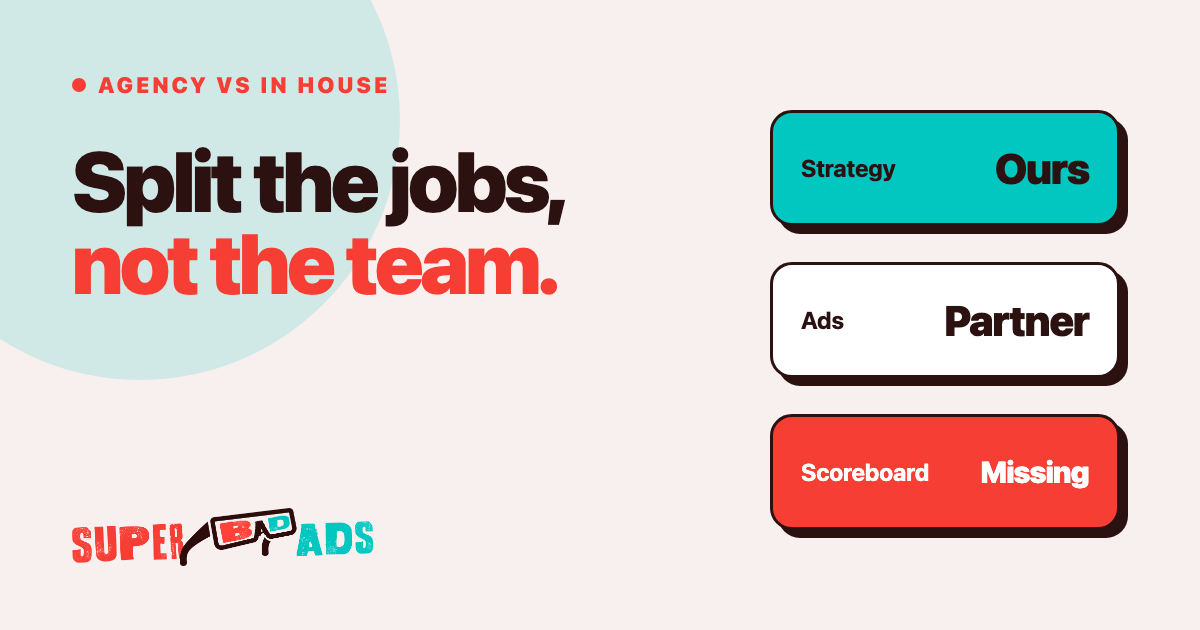
For a multi-location operator, marketing agency vs in house is a question of which jobs, not which team. Keep strategy, brand voice, front desk follow-up and local knowledge in house, and give paid media buying, creative testing and per-location reporting to a specialist. Most groups end up with a hybrid: one in-house marketing lead plus a paid media partner, both judged on one weekly scoreboard of new clients per location from the booking system.
The usual marketing agency vs in house comparison lists pros and cons as if the decision were all or nothing, which rarely fits an owner with a group of gyms, salons or barbershops. This guide sets out the split, compares the options and explains how to change your setup without losing bookings.
Which marketing jobs belong in house?
The jobs that belong in house depend on daily contact with your locations, staff and clients. The US Bureau of Labor Statistics describes the role this way: "Advertising, promotions, and marketing managers plan programs to generate interest in products or services." For a multi-location operator, that marketing strategy decides which locations need new clients and which offers the front desk can run.
- Strategy and priorities: which locations and services get attention this quarter. A written paid media strategy turns those priorities into a budget by location.
- Brand and local voice: organic social media marketing from your own chairs, studios and classes, captured cheaply on a phone, since most operators are not Nike.
- Front desk follow-up: calling back every new inquiry and rebooking clients at checkout. Our guide to speed to lead covers the habits that protect paid leads.
- Local knowledge and reviews: each location's Google Business Profile and review requests.
- The scoreboard: owning the weekly numbers, so that any outside help answers to the business.
Which marketing jobs should go to a specialist?
The jobs that suit a specialist improve with repetition, because a team of experts running Meta and Google campaigns for many locations sees platform changes and creative fatigue earlier than a single in-house buyer.
- Paid media buying per location: campaign structure, targeting by radius, and budgets moved toward the locations with open appointment time.
- Creative testing: cheap, representative ads tested as small bets, with winners called on booked first-time clients rather than click rate.
- Reporting stricter than the platforms: cost per new client for every location, counted in your booking system.
One person with the right skill set can handle these jobs for a single location, but across many locations the buying and testing alone can fill a working week, and strategy slips first.
How do an agency and an in-house team compare?
An agency and an in-house team differ less on talent than on focus, depth and control, and the hybrid takes the strongest column from each. The table compares them on the capabilities that matter to a multi-location owner. It contains no prices, because the most cost effective option depends on which jobs your marketing budget must cover.
| Capability | In-house team | Paid media agency | Hybrid: in-house lead plus paid media partner |
|---|---|---|---|
| Knowledge of your locations, staff and clients | Deep and daily | Learned through onboarding and weekly calls | Deep, held by the in-house lead |
| Depth in Meta and Google buying | Depends on one or two marketing professionals | Specialists working across many accounts | Specialists, directed by the lead |
| Creative testing | Limited by available time | Steady, with a written test log | Steady, with local assets from the lead |
| Front desk follow-up and local reviews | Owned in house | Outside the agency's reach | Owned in house |
| Cover during vacations or turnover | A gap when someone leaves | A team covers the account | Each side covers the other |
| Per-location reporting | Often built by hand | Varies, so ask for the booking system count | One scoreboard both sides answer to |
| Control of accounts and data | Full | Full only when the business owns every account | Full, because the business owns every account |
| Time to start | A hire takes time to find and train | Faster once access is granted | Either side can start first |
That table answers the in house marketing team vs agency question, because neither column alone covers every row. If you decide to hire an agency, our guide on how to choose a marketing agency explains what to check before you sign.
What does the hybrid model look like?
The hybrid answer to marketing agency vs in house gives one in-house marketing lead, or a small internal marketing team, ownership of strategy, brand, local work and the scoreboard, and it gives an agency partner ownership of paid media buying, testing and reporting. The lead sets monthly priorities, and the partner turns them into campaigns and tests for every location.
The two sides meet weekly around one scoreboard: new clients per location, cost per new client, open appointment time and the week's changes, in writing. When a location falls behind, the scoreboard shows whether the fix sits in the ads or at the front desk. In house vs agency marketing then stops being a contest, and the marketing efforts of both sides build on each other over the long term.
Should you hire in house first or bring in an agency first?
In the in house marketing vs agency decision, the right order depends on which gap costs more today. Hire in house first when nobody owns the plan or the front desk drops new inquiries, because an agency can't fix those from outside. Bring in a paid media specialist first when a capable lead spends the week inside ad accounts, or when you doubt your agency but have no booking-system numbers.
Before hiring a marketing agency or replacing one, ask for last quarter's spend and new clients per location from the booking system. If nobody can produce that report, the scoreboard is the first job to fix, and our list of questions to ask a marketing agency helps structure that conversation.
How do you change the setup without losing bookings?
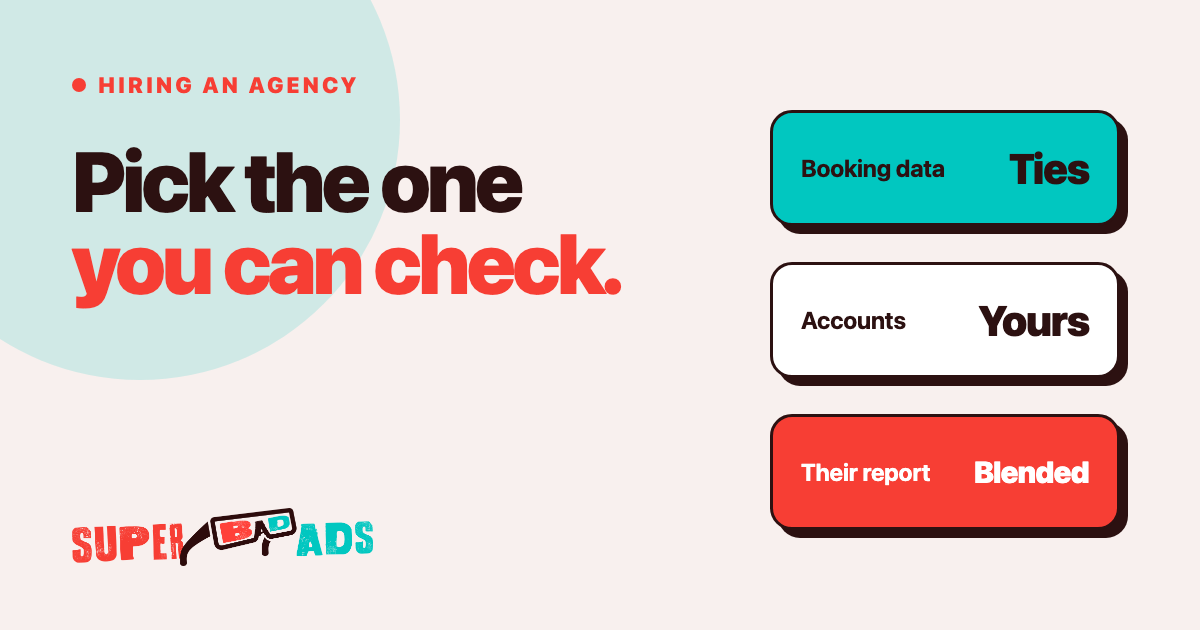
Whichever way the agency vs in house marketing decision goes, change the setup in three steps: audit first, run an overlap, and make sure the business owns every account and pixel. An audit tells you what works before anything is switched off; our marketing audit post shows what a thorough one inspects. During the overlap, working campaigns keep running.
The business, not the agency or one employee, should hold admin access to every ad account, pixel and Google Business Profile. Google's help center warns that "if your account has only one administrator, you may lose access to your tags if that user becomes unavailable." Add a second administrator from inside the business, and give every outside team its own logins. For a multi-location gym operator that switched agencies, paid-search ROAS went from 0.15x to 1.62x by month 3 on flat spend.
Where to start
Super Bad Ads is the paid media partner for multi-location operators, including grooming, salon and fitness groups, and we work alongside in-house marketing leads. We run Meta and Google for every location and report new clients per location every week, counted in your booking system and stricter than the platform numbers. See how we work as a paid media agency.
For your group, the marketing agency vs in house decision starts with a list of every marketing job, each marked in house or specialist.
FAQ
Is it cheaper to hire an in-house marketer or a marketing agency?
Whether it's cheaper to hire an in-house marketer or a marketing agency depends on the jobs, not on the headline cost. A salary buys one person's time across every job, while an agency fee buys a team for specific jobs. Compare the cost of each job done well, including cover during turnover.
Can a marketing agency work with an in-house marketing team?
A marketing agency can work well with an in-house marketing team when the jobs are split in writing. The in-house lead owns strategy, brand, local work and front desk follow-up, and the agency owns paid media buying, testing and reporting. Both sides meet weekly around one per-location scoreboard.
Should a multi-location business hire a marketing manager before an agency?
A multi-location business should hire a marketing manager before an agency when nobody owns the plan, the brand or front desk follow-up. When a capable lead spends most of the week inside ad accounts, a paid media specialist comes first, so the lead can return to strategy.
Who should own the ad accounts when a business uses an agency?
The business should own the ad accounts when it uses an agency, along with every pixel, analytics property and Google Business Profile. The agency receives access through its own logins, so the business keeps its history and data if the relationship ends.
Split the jobs, keep one scoreboard
Marketing agency vs in house is rarely an either-or choice: keep the jobs that need inside knowledge in house, give paid media to a specialist, and judge both on one weekly scoreboard. For help running paid media for every location alongside your in-house team, Get Started.
Find out what your ad spend actually books.
We instrument the whole funnel — lead to booked to showed to revenue — and buy media against the number that matters. No calendar invites, no sales-call bait. Just the build.
Get Started →