
How to Get More Gym Members: A Plan for Multi-Club Operators
How to get more gym members across a multi-club group: build the per-club joins scoreboard first, fix follow-up speed, fund local paid media at the clubs with capacity, test cheap creative, and grow referrals and retention.
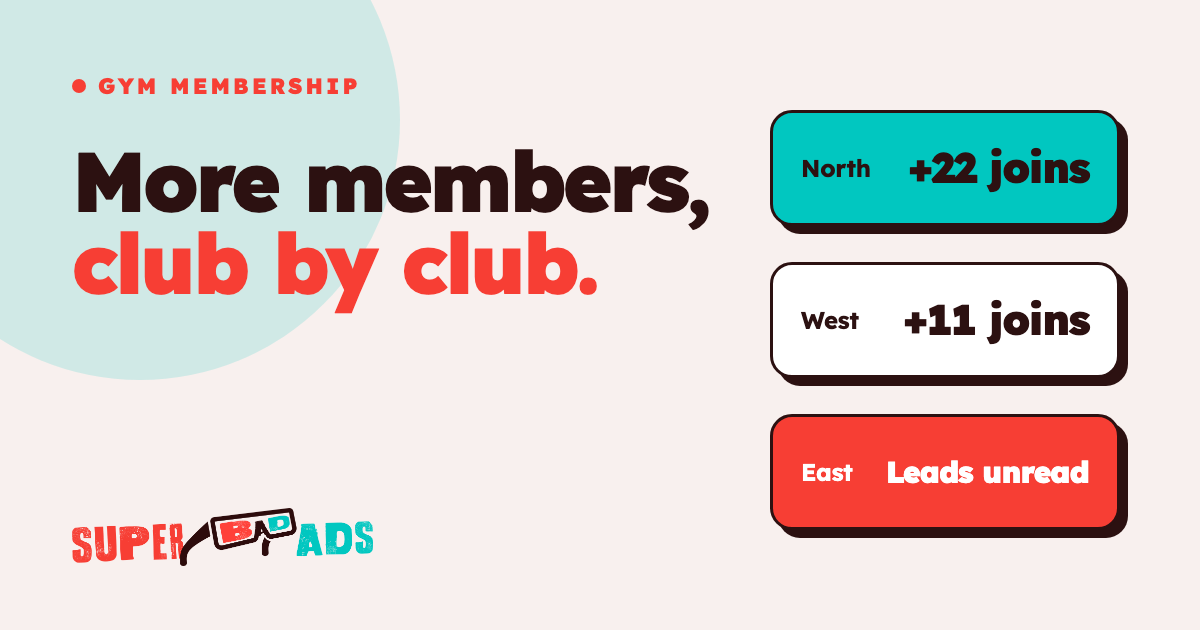
The way to get more gym members across a multi-club group is to work the levers in order: build a scoreboard of joins per club from the membership system, fix how fast the front desk follows up on every inquiry, fund local paid media only at the clubs with capacity, test cheap representative creative, and then grow referrals and retention. Each step depends on the one before it, and each one is judged by new members per club rather than by clicks or leads.
Most advice on how to get more gym members is written for a single gym, so it offers a long list of tactics and assumes the owner can watch the results at the front desk. A new head of marketing at a group with 8 or 40 clubs needs something else: a short, ordered plan that the board can follow, and a way to show club by club that membership growth is real. The sections below lay out that plan.
What actually brings new members into a gym?
New members come from a small number of sources, and most of them are local. People choose a gym that is close to home or work, so the strongest demand is in the few miles around each club.
- Local paid media around each club: Meta ads targeted to each club's radius create awareness among people who are not yet searching, while Google Ads reach people who are already looking for a gym nearby.
- Local search and Google Business Profile: accurate hours, photos and reviews for every club, supported by local SEO for multiple locations, keep each club visible when people search for fitness options in their area.
- A clear trial or intro offer: a free class, a short trial pass or a seasonal fitness challenge lowers the barrier for someone comparing two or three gyms in the same area.
- Tours and front desk follow-up: a lead becomes a member only after someone calls, books a tour and closes the sale, so follow-up is part of marketing, not separate from it.
- Referrals from current members: a structured gym referral program brings in prospects who already know someone at the club, and they tend to join at a higher rate than cold leads.
- Retention: keeping current members protects net growth, because every cancellation offsets a new join.
These are the core gym marketing ideas and gym membership marketing ideas for a multi-club group, and they apply to any fitness business with several locations across the fitness industry, whether the buyer is a gym owner with eight clubs or a marketing lead reporting to a board. The difference between groups that grow and groups that stall is usually not which ideas they choose but the order in which they apply them.
In what order should a multi-club group work on them?
Launching every initiative at once spreads the budget thin and makes it impossible to see what worked. A multi-club group should work through the levers in this order:
- Build the scoreboard: report joins and cost per member for every club, every week, from the membership system. Paid media should answer to that system, per location, and its reporting should be stricter than the ad platforms' own numbers.
- Fix follow-up speed: before buying more leads, make sure every club responds quickly and books tours consistently.
- Fund local paid media at the clubs with capacity: direct spend toward clubs that can take new members, and reduce it at clubs that are near capacity.
- Test creative: use cheap, representative photos and short videos of your real clubs, tested as many small variations, and scale the versions that produce joins.
- Grow referrals: formalize the referral program once the basics are working, so engaged members bring in new ones at a lower cost.
- Protect retention: track attendance and reach out to members who stop visiting, because net growth depends on keeping the members you already have.
Skipping the scoreboard leaves the group unable to judge any of the later steps, and skipping follow-up means paying for leads that nobody calls. Working in order ensures each investment builds on a measured foundation.

Which gym marketing ideas work best at each stage of the member journey?
A useful way to organize gym marketing ideas is by the stage of the member journey they serve. Each stage has a different job and a different measure on the scoreboard.
- Awareness in each club's neighborhood: local Meta ads, video of real members and real coaches, and visible community involvement introduce each club to the target audience nearby. Measure awareness by the inquiries and trial sign-ups each club receives, not by impressions.
- Consideration and comparison: prospects compare price, location, hours and atmosphere across two or three gyms. Accurate listings, recent reviews and a website page for each club that shows the facility, the schedule and the trial offer help a prospect choose your club. Measure this stage by the share of website visitors who request a tour or start a trial.
- The first visit and the tour: the tour is where most memberships are won or lost. A consistent tour script, a clear explanation of membership options and a direct ask to join turn a visit into a sale. Measure it by the close rate on tours at each club.
- The first ninety days: new members who build a habit early are far more likely to stay. Welcome messages, an introductory session with a coach and a check-in after the first few weeks protect the investment made to acquire them. Measure it by early cancellations by club.
- Long-term retention and referral: engaged members renew and bring friends. Recognize milestones, ask satisfied members for referrals, and reach out to members whose attendance drops. Measure it by retention and referred joins per club.
Organizing ideas this way also shows where a club is losing members. A club with many inquiries but few tours has a follow-up problem; a club with many tours but few joins has a sales problem; and a club with many joins but rising cancellations has an onboarding problem. Each requires a different fix, and only the per-club scoreboard makes the difference visible.
How should the budget be divided between clubs?
Equal budgets for every club rarely make sense. A club that is close to capacity, with busy peak hours and a waiting list for classes, gains little from more advertising and can even frustrate current members if new joins crowd the floor. A newer club, or one that has lost members after a competitor opened nearby, needs a larger share of the budget to rebuild its base.
Review capacity and joins weekly, and move spend toward the clubs that can take new members. A new club should receive a dedicated launch budget before and after opening, then move to the standard weekly review once its membership stabilizes. This approach requires that your company owns every ad account and pixel, so that budget can move quickly and the history stays with the business if an agency relationship ends.
How fast should the front desk follow up?
Many leads are lost in follow-up. A person who asks about membership is most interested at the moment they ask, and a reply that arrives hours later often reaches someone who has already toured another gym. Club staff balance check-ins, tours and member questions, so online inquiries can wait unless there is a clear standard.
Set a response standard for every club, measured in minutes during staffed hours, and give the front desk a short script that captures the prospect's name, contact details and preferred tour time. Then report the booked tour percentage, meaning the share of inquiries that become scheduled tours, next to the lead count for each club. When the booked percentage falls at one club while lead volume holds steady, the problem is follow-up, and the fix is coaching rather than more advertising.
What should the membership system report for the scoreboard?
The scoreboard is only as reliable as the gym management software behind it. Most multi-club groups already run a membership or club management system that records leads, tours, joins, cancellations and attendance. The marketing plan should draw on that system directly instead of on exports from the ad platforms, because it is the record the finance team and the board already trust.
At a minimum, the system should let you report each of these by club and by week: new leads and where they came from, tours booked and tours completed, joins and the membership type sold, cancellations and freezes, and attendance for members in their first ninety days. If any of these is missing or recorded inconsistently from one club to the next, fix the data entry before you change the marketing budget, because every later decision depends on those numbers.
The same system also shows whether new members stay. Members who keep coming back are usually the ones who see progress toward their fitness goals, so attendance in the first few months is the best early warning of a cancellation. A club that keeps members engaged through onboarding sessions, coaching check-ins and class recommendations will turn more of its new joins into long-term members, which means every marketing dollar spent at that club produces more lasting growth.
When the scoreboard, the follow-up standard and the budget review all run from the same system, the marketing lead can explain to the board exactly where new members came from, what they cost and how many stayed. That clarity is what turns a membership plan from a list of tactics into a plan the board can approve.
How do you prove membership growth is incremental?
The people who approve the budget, whether owners, a CFO or a board, will not accept platform-reported conversions on their own, because ad platforms claim credit for people who would have joined anyway. Growth is incremental only if it would not have happened without the marketing.
The clearest proof comes from flat-spend comparisons and quarter-over-quarter progress by club. If spend holds steady while joins per club rise, the improvement comes from better execution rather than a larger budget. Proper marketing attribution ties each join in the membership system back to the campaign that produced it, so the scoreboard shows real members rather than clicks.
This is how a gym group can show that a change of approach worked. One multi-location gym operator that switched agencies went from 0.15x to 1.62x paid-search ROAS by month three on flat spend, and a multi-location gym group grew new online members by 259%. More examples are in our case studies.
| Metric | Source | How often | | :--- | :--- | :--- | | Joins per club | Membership system | Weekly | | Cost per member | Ad spend divided by joins | Weekly | | Booked tour percentage | Front desk records | Weekly | | Member retention | Billing system | Quarterly |
FAQ
How do you increase gym membership without raising the budget? Start with follow-up speed and budget allocation. Faster responses turn more existing leads into tours, and moving spend from full clubs to clubs with capacity produces more joins from the same budget. Then measure joins per club at flat spend to confirm the gain.
How do you attract new gym members to a new club? Begin before opening with a clear intro offer and local ads around the new club. Test several creative versions early, keep the ones that produce joins, and add the club to the weekly scoreboard from the first day so its launch can be compared with earlier openings.
Should every club run its own marketing? Clubs should share one brand rather than each running its own. The central team should produce the creative and manage paid media, while each club handles tours and follow-up. That keeps the brand consistent and lets the budget move to the clubs that need members.
How do you know if your agency is helping the gym grow? Ask for joins per club per week from your membership system, cost per member, and flat-spend comparisons. If the agency can only show clicks, impressions or platform-reported results, it cannot prove that it is growing your membership. Our paid media agency reports in exactly those terms.
Where to start
Super Bad Ads runs paid media for gym groups and multi-club operators. We buy Meta and Google for every club, count joins from your membership system, and report new members and cost per member for each club, every week. Our multi-location marketing agency services start from that scoreboard; see how we work as a gym marketing agency.
Knowing how to grow a gym group starts with seeing the numbers clearly for every club. Build the per-club joins scoreboard from your membership system before changing any spend, then work through the levers in order. For help building it, Get Started.
Find out what your ad spend actually books.
We instrument the whole funnel — lead to booked to showed to revenue — and buy media against the number that matters. No calendar invites, no sales-call bait. Just the build.
Get Started →