
A Franchise Social Media Marketing Program Per Unit
Franchise social media marketing works when the brand owns every page, splits the posting jobs with franchisees, shares a content library with written approval rules, funds paid social by unit and judges results in booked customers per unit from the booking system.
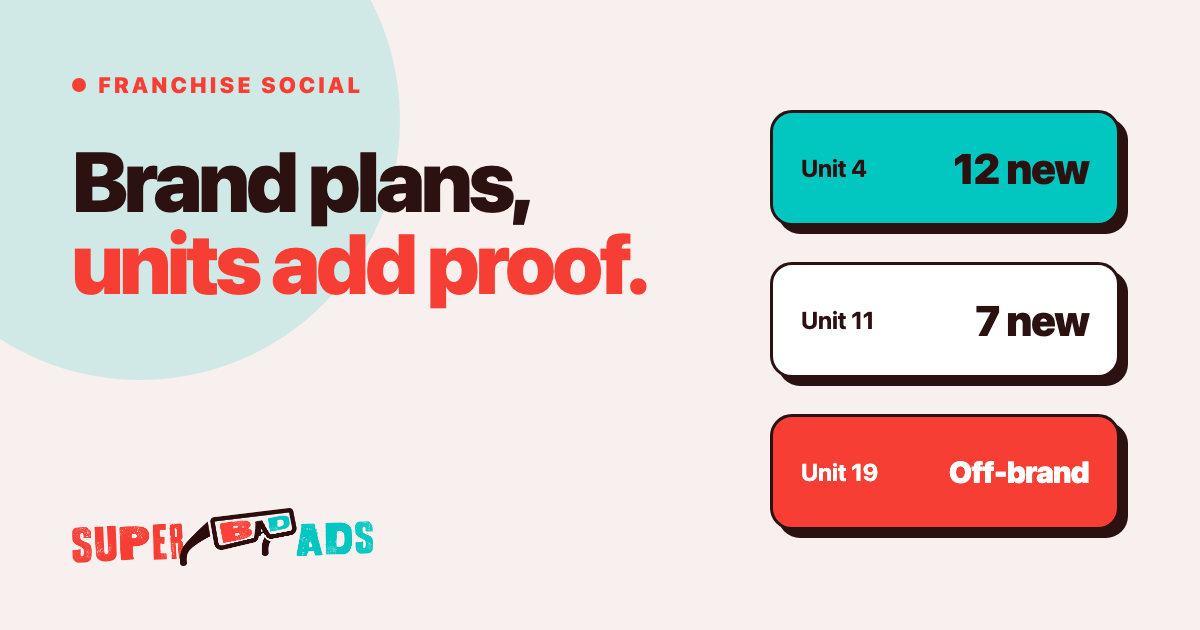
Franchise social media marketing works when the franchisor owns every page and ad account, the brand posts campaigns while each franchisee posts local proof from a shared content library under written approval rules, paid social is funded by the brand fund or a local co-op and run by unit, and results are judged in booked customers per unit from the booking system.
Most guides on this topic compare scheduling tools, but for a franchise business the tool matters far less than the split of jobs between the brand team that manages social media centrally and the franchisees who know their local audiences. This guide is for the marketing lead who owns the brand fund in a system with dozens of units.
Who should own the social media accounts in a franchise system?
The brand should own every social account in the system, because those accounts carry the brand identity every unit shares: one brand page on each platform, plus a location page for each unit under the brand's business account. The central team keeps admin rights, and each franchisee receives editor access to their own location page, so they can post and reply without the power to delete or rename it.
Brand ownership also protects the system when a unit changes hands, because the followers, reviews and post history stay with the location page and the brand moves editor access to the new owner. Map listings follow the same rule, as our guide to local seo for franchises explains.
What should the brand post, and what should each franchisee post?
A franchise social media strategy works best when each side owns the content it makes better. The brand team is good at social media campaigns, offers, brand awareness and polished creative, while franchisees are good at creating content with local proof that makes a unit feel real to its target audience: the team, the space, the regulars and the neighborhood events. The table below sets out the split.
| Job on social | Brand team | Franchisee | Approval rule |
|---|---|---|---|
| Brand campaigns and seasonal themes | Plans and produces them | Shares them to the location page | None; library posts go live as supplied |
| System-wide offers | Writes the offer and the terms | Posts the approved version only | Brand approval before any change |
| Local proof (team, space, customers) | Supplies templates and examples | Films and posts it each week | Follows the written guardrails |
| Local events and partnerships | Supplies a post format | Writes and posts it | Follows the written guardrails |
| Comments and messages | Handles brand page and escalations | Replies on the location page | Escalates complaints to the brand |
| Paid social by unit | Runs it in brand-owned ad accounts | Supplies local footage and capacity | Brand approves every ad |
This split is the core of franchise social media management: the brand controls what carries legal or financial risk, such as offers and ads, and the franchisee controls what depends on local knowledge.
How do you build a content library franchisees will use?
A content library is a shared folder of ready-to-post material, organized by month, with captions, approved hashtags and the brand's branding guidelines. It should cover most of a unit's posting, so that a franchisee who is busy with customer service at the front desk can still keep the location page active.
The library works best when it leaves room for localized customization and local content. The most useful templates include a slot for a short video from the unit, such as a stylist finishing a cut, because cheap, representative clips reach potential customers without a national production budget. Short clips also raise the platform question; our comparison of Reels vs TikTok covers where each one fits.
The same footage feeds the paid program, where cheap creative earns its place in tests. For a 30+ location grooming brand, cost per new client fell 34.3% against a static-only baseline. The brand team should collect the best local clips each month and return the winners to the library.
What guardrails should franchisees follow on social media?
Social media for franchises carries a legal risk that a single business doesn't face, because every franchisee and employee can post under the brand's name. The Federal Trade Commission states: "Your company is ultimately responsible for what others do on your behalf." The same guidance adds that "Advertisers need to have reasonable programs in place to train and monitor members of their network."
That network keeps growing. In its 2026 outlook, the International Franchise Association states that "Franchise employment is anticipated to increase by more than 150,000 jobs (1.8%) to nearly 8.9 million jobs." A one-page set of guardrails, signed by each franchisee, should cover these points:
- Claims: no promises of results, no health or income claims and no named competitor comparisons without brand approval.
- Offers and prices: only the library offers, in the brand's wording, so a customer never sees a price the front desk can't honor.
- Endorsements: employees, friends and paid or gifted influencers must disclose their connection, because, in the FTC's words, disclosure "helps readers decide how much weight to give the review."
- Customer photos: only with the customer's written permission, removed on request.
The final wording should be checked with your franchise counsel. Posts that recruit new franchise owners fall under franchise sales rules, so they belong with the franchise development team rather than with franchisees.
How should the brand fund or a local co-op pay for social ads by unit?
Organic posts keep a location page credible, but paid social puts a unit in front of potential customers nearby, and it's the part of digital marketing that handles lead generation for each unit. In most systems, the brand fund pays for creative and brand-level campaigns, while local ad spend or a regional co-op pays for the ads that serve a specific unit. Our guide to franchise marketing strategy explains how to divide those budgets.
Every unit's paid social should run inside brand-owned ad accounts, with a campaign for each territory and a budget set by each unit's open capacity, which the booking system shows. Our guide to franchise advertising covers account ownership and territory targeting.
How do you measure franchise social media marketing in booked customers per unit?
A franchisor should measure franchise social media marketing in booked customers per unit per week, counted in the booking system and set next to that unit's paid social spend, because likes and reach don't show whether anyone came through the door.
A useful weekly scoreboard for social media marketing for franchises has four lines for each unit: new customers booked, paid social spend, cost per new customer and posts on the location page.
This is the same per-location discipline that our guide to multi location marketing applies to every channel. For an 8-location California fitness operator, locations with per-location attribution went from 0 of 8 to 8 of 8, and cost per lead fell 25% by month 3.
Where to start
Super Bad Ads is the paid media partner for multi-location operators, including franchise systems in grooming and fitness. We run Meta and Google for every unit and report booked customers per unit every week, counted in your booking system and reported stricter than the platform numbers. See how we work as a franchise marketing agency and as a paid media agency for marketing teams of one to three people.
For your own franchise social media program, the first step is two one-page documents: an account map that lists every page and who holds admin and editor access, and the franchisee guardrails for claims, offers, endorsements and customer photos. These two documents give the brand team the basis for a weekly scoreboard of booked customers per unit.
FAQ
Should each franchise location have its own social media page?
Each franchise location should have its own social media page in most systems, created as a location page under the brand's business account. The brand keeps admin rights and the franchisee posts as an editor, so local followers, reviews and history stay with the location when ownership changes.
Should franchisees be allowed to post on social media on their own?
Franchisees should be allowed to post on social media on their own within written guardrails. Library posts can go live without review, while local posts follow rules for claims, offers, endorsements and customer photos. Offers and paid ads should always need the brand team's approval before they go live.
Who pays for social media advertising in a franchise system?
Social media advertising in a franchise system is usually paid for from two sources. The brand fund pays for creative, the content library and brand-level campaigns, while local ad spend or a regional co-op pays for the ads that bring customers to each unit, run inside brand-owned ad accounts.
How should a franchisor measure franchise social media marketing?
A franchisor should measure franchise social media marketing in booked customers per unit per week, counted in the booking system and set next to each unit's paid social spend. Likes and reach can track page activity, but booked customers are the number franchisees and the advisory council trust.
Run social for every unit
Franchise social media marketing that franchisees trust rests on brand-owned pages, a clear split of posting jobs, written guardrails and one weekly scoreboard. For help running paid social for every unit, with results counted in your booking system, Get Started.
Find out what your ad spend actually books.
We instrument the whole funnel — lead to booked to showed to revenue — and buy media against the number that matters. No calendar invites, no sales-call bait. Just the build.
Get Started →