
Dental Marketing Strategies for a Group With Many Offices
For a dental group with many offices, a marketing strategy is a plan per office: goals in new patients, one job per channel, budget split by open chair time, a yearly calendar and a monthly review the partners can read.
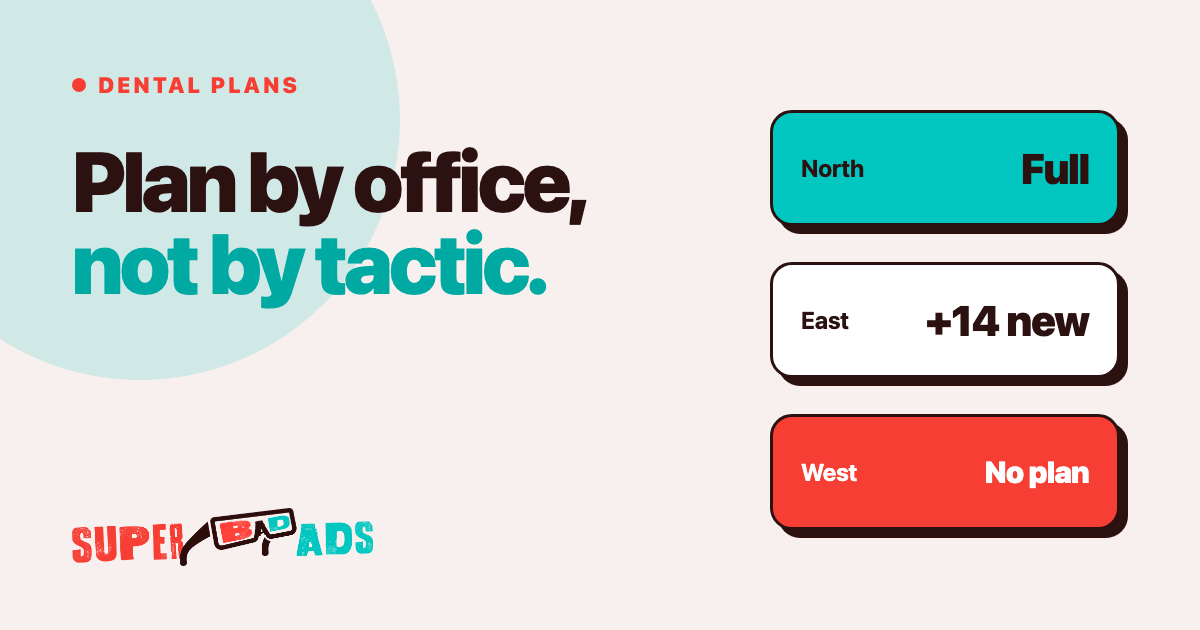
The dental marketing strategies that hold up for a group with many offices start with a plan per office, not a list of tactics. Each office gets a goal in new patients per month from the practice management system, each channel gets one job in attracting new patients, the budget follows open chair time, and the partners review one per-office scoreboard every month.
Budget season has started, and the CFO wants next year's plan with a number for every office. Many dental practice marketing strategies are written for a single practice and list tactics without saying how to divide money across 6 to 40 offices or how to show the partners what it produced. This guide gives a marketing lead the structure for that plan.
What should a dental group's marketing plan measure?
The plan should measure new patients per office per month, counted in your practice management system, whether that's Dentrix, Open Dental, Eaglesoft or Denticon. Clicks, phone number calls and form fills from potential patients help with day-to-day optimization, but they don't tell the CEO, CFO or partner dentists how many new patients each office saw.
That count should stay inside the group's own systems. We count new patients in your practice management system and report them next to spend for each office; patient records and booking data aren't sent to Google, Meta or any other ad platform. If your current reports can't connect spend to new patients by office, our guide to multi-location dental paid media explains how to set up that measurement first.
Agree on this definition before the plan goes to the partners. When everyone uses the same count from the same system, the monthly review can focus on decisions instead of debates about whose numbers are right.
Which channels belong in a dental marketing strategy, and what is each one's job?
A strong dental marketing plan gives every channel one clear job, so the partners can judge each one by what it adds to the schedule:
- Google Business Profile and local search: these build each office's online presence and reach people near the office who are looking for dental care now. Google Business Profile Help explains that local results are mainly based on relevance, distance and popularity, so each office needs a complete profile with accurate business hours and a steady flow of online reviews, which also helps with building trust. Search engine optimization for each office's service pages matters too, and our guide to local SEO for multiple locations covers the setup.
- Paid search: Google search campaigns capture active demand from people searching for a new dentist, an emergency visit or a specific treatment. Each office needs its own location target; Google Ads Help notes that radius targeting requires a radius of at least 1 km around a location. Our guide to google ads for dentists covers the account setup for each office.
- Paid social: Meta ads build interest before people search, which suits high-consideration services such as clear aligners or implants. Simple creative featuring your own dentists and teams can work well without expensive productions. Our guide to dental social media marketing covers how to run it across every office.
- Recall and reactivation: email marketing and recall campaigns to existing patients are often the fastest way to fill open hygiene time and protect the patient base. The ADA Health Policy Institute reports that 53% of adults ages 19 to 64 with private dental insurance had at least one dental visit in 2024, against 17% with no dental insurance, so many insured patients had no dental visit that year.
- Referrals: a written referral process at the front desk, supported by a good patient experience, gives each office a steady source of new patients. Among the dental marketing ideas a group can use, a referral routine is easier to run when every office follows the same process. Our guide on how to get more dental patients puts these sources in order for a group.
How should a dental group split its marketing budget across offices?
Many marketing strategies for dentists split money evenly, but a group should split the budget by each office's open chair time and hygiene capacity. An office that's booked out for weeks doesn't need heavy new-patient spend, while an office with open hygiene and new-patient time needs more. An even split can send money to offices with no open capacity.
New offices should receive a launch window with a larger share of the budget before and after opening, to add bookings while the team builds its local reputation. Plan that window in the calendar, and move the office to the normal capacity rule once its schedule is steady.
Mature offices with full schedules can run on a smaller budget that protects their brand searches and supports higher-value services. Review the split every month against open capacity, and move money between offices when capacity changes. This rule gives the CFO a clear reason for every allocation, and it shows which offices need help that marketing alone can't provide, such as more hygienist hours.
What should a yearly dental marketing calendar include?
A yearly calendar keeps the plan ahead of the schedule instead of reacting to it. Start with the dates that change capacity: new office openings, new providers, remodels and holidays when offices close.
Mark the months that are usually slow for your offices, based on last year's new patients per office, and plan recall and reactivation marketing campaigns before those months arrive. Let the front desk answer any coverage questions that come up during recall pushes.
Finally, place the monthly reviews and any planned tests on the calendar, so the partners know when they'll see results and when a decision is due.
How do you review dental marketing strategies with the partners every month?
Use one table per office, on the same lines every month. The partners should be able to read it without a translator, and the marketing lead should be able to forward it unedited.
| Plan line | What it shows | Source |
|---|---|---|
| New patients | First visits by new patients at each office | Practice management system |
| Goal | The new-patient goal set for each office in the plan | Annual plan |
| Ad spend | What each office's campaigns cost this month | Google Ads and Meta |
| Cost per new patient | Ad spend divided by new patients, per office | Calculated from the lines above |
| Open capacity | Hygiene and new-patient openings in the coming weeks | Practice management schedule |
Read the lines together to decide where the budget should move next. An office below its goal with open capacity may need more budget or a closer look at call handling, while an office above its goal with no open time can give budget to another office. If the numbers still don't match between systems, our guide on why your booking system and ad platform disagree explains the usual causes.
How do you test a change before moving budget across offices?
Test a change in a few offices before you move the whole group's budget. Keep spend flat in comparable offices, make the change in the test offices, and compare new patients per office over the same period. This flat-spend comparison helps show whether the change added new patients or only took credit for demand that already existed. Our guide to what is marketing attribution explains how that credit gets assigned.
Outside dental, a multi-location gym operator that switched agencies went from 0.15x to 1.62x paid-search ROAS by month 3 on flat spend. That's a gym result, not a dental one; the point is that holding spend flat made the change visible location by location.
Where to start
Super Bad Ads is the paid media partner for multi-location operators, including dental groups. We run Google and Meta for every office and report new patients per office every week, counted in your practice management system, not in the ad platform.
We start with an audit of your current accounts, run new campaigns alongside what already works, and make sure your group owns every account. Learn how we work with groups as a dental marketing agency, or see our approach as a paid media agency across every location type we serve.
FAQ
What is the difference between dental marketing ideas and a dental marketing strategy?
Dental marketing ideas are individual tactics, such as a referral program or a review routine. A dental marketing strategy is the plan that decides which tactics each office uses, what each channel's job is, how the budget is divided by open chair time, and how results are reviewed each month.
How should a dental group set marketing goals for each office?
Set each office's goal in new patients per month, counted in the practice management system. Base the goal on last year's results and the office's open capacity, then review it monthly with the partners so the goal and the budget stay connected.
Should every dental office get the same marketing budget?
Dental groups with uneven capacity usually need an uneven marketing budget. Offices with open hygiene and new-patient time, and new offices in their launch window, usually need a larger share, while fully booked offices need less. Review the split every month as capacity changes.
How can a dental group track new patients from marketing without sharing patient data?
A dental group can count new patients in its own practice management system and compare that count with ad spend for each office. Patient records stay in the practice systems; the monthly report shows totals per office next to spend.
Write next year's plan per office, set the budget by open chair time, and review one per-office scoreboard every month. When you want help running paid media across every office, Get Started.
Find out what your ad spend actually books.
We instrument the whole funnel — lead to booked to showed to revenue — and buy media against the number that matters. No calendar invites, no sales-call bait. Just the build.
Get Started →