
Creative Testing Without a Production Budget
Creative testing for a multi-location operator is a weekly habit, not a production budget: one hypothesis, a control against a few cheap representative ads at a few test locations, and a winner called on booked first-time clients from the booking system.
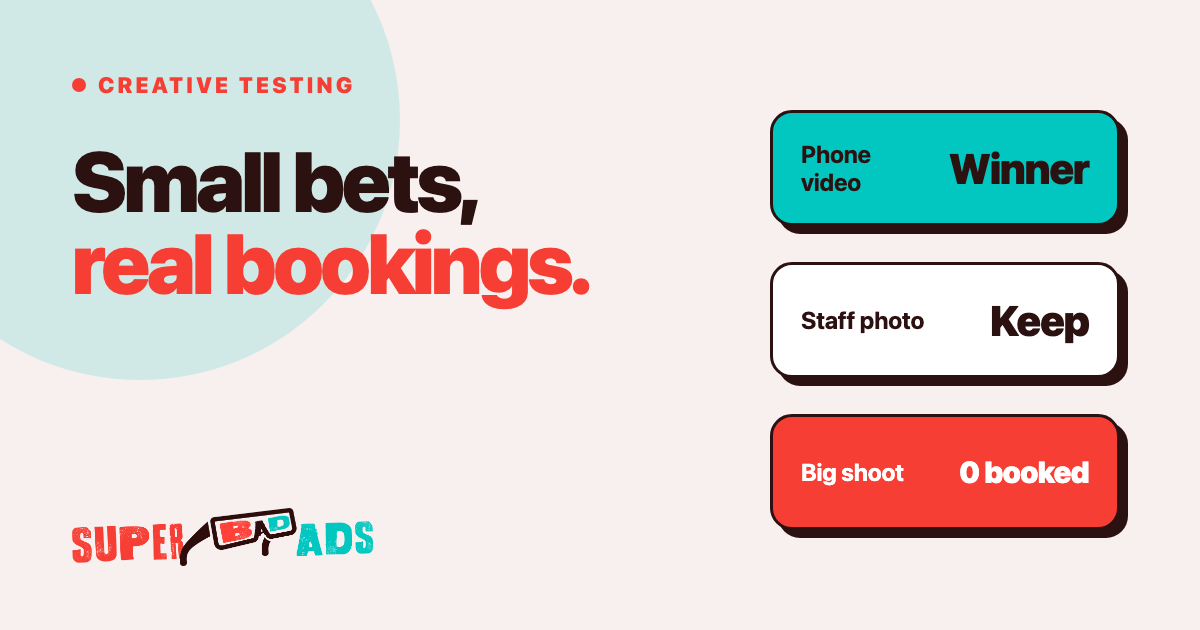
Creative testing for a multi-location operator means writing one hypothesis, running a control ad against a few cheap, representative variants at a few test locations, and calling the winner on booked first-time clients from your booking system, not on click rate. Winning creative variations then roll out to the other locations, and every result is recorded in a test log that the whole team can read.
A polished shoot and a large production budget are not required for this work, because most groups with several locations learn more from ten phone videos made in their own chairs, studios and classes than from one expensive shoot. Each single ad is a small bet, and the booking system shows which bets paid in first-time clients. This guide sets out a creative testing framework for creative testing ads on Meta and Google that a marketing lead can run every month and forward, unedited, to the owner or the CFO.
What is creative testing, and how is it different from A/B testing?
Creative testing is the practice of comparing ads against each other to learn which creative concept, message or format brings in new clients, and it treats creative performance as something to measure rather than something to debate. A/B testing, often called split testing, is one method inside it: a platform tool that splits a target audience in two and compares the results of each half. For a national brand with large daily volume, the platform split tool can carry most of the job on its own.
A local operator faces a different problem, because each location draws from a small radius and the platform tools need more volume than one location usually produces. Google's own guidance on custom experiments says: "For reliable results, ensure your base campaigns meet minimum requirements, such as more than 100 daily conversions." Since a single barbershop, gym or studio seldom books that many new clients in a day, we run ad creative testing across a few chosen test locations and read the result in the booking system, where each booked first-time client is counted once.
Operators who are still choosing formats can start with our guide to types of social media ads, which explains what each format does well; the rest of this post explains how to run tests on them.
What should you test first?
Start with a written hypothesis before any budget goes live. A good hypothesis names one change and the result you expect, for example: "A phone video of a stylist finishing a cut will book more first-time clients than our current static offer image."
Each test should change one variable while holding the other creative elements steady, and Meta's advice on A/B testing is direct on this point: "Select one variable to test and discover what your audience engages with most." When the hook, the offer and the person on screen all change at once, nobody can tell which change moved bookings, so the test teaches the team nothing it can reuse. Good first variables and messaging angles for a multi-location operator include:
- The opening hook: the first two seconds of a video, or the headline on an image.
- The intro offer: what a first-time client gets, written the same way at every location.
- The face: a staff member from the location against a brand graphic.
- The format: the same script as a vertical video against a still image; our comparison of Reels vs TikTok explains how the two short-form placements differ before you choose one for the test.
Use cheap, representative assets made inside your own locations. We are not Nike, and most operators aren't either: a clear phone video of a real class, a real chair or a real front desk shows the experience a new client will get, and it costs little enough that you can test several ideas each month.
How many ads should one creative test include?
Our rule of thumb is one control and three to five variants. The control is your current top performer, the benchmark a new idea must beat, while the variants each carry the hypothesis in a slightly different way, so that one weak execution does not sink a good idea.
Adding more ads than that spreads a small local budget too thin, because each ad receives too few impressions to book anyone and the platform tends to favor whichever ad draws cheap clicks early. Google's guidance on testing creative messages supports a narrow test: "Limit how many elements you test within your ads." The same discipline applies to creative testing meta ads, where Meta's own test tools work best with one clear difference between the ads.
How much should you spend on a creative test per location?
Set the test budget per location from what that location can realistically book, not from a share of the total budget. The test needs enough spend to produce booked first-time clients you can count; a test that books two people at each location can't tell you much.
For that reason, we run tests at a few locations first rather than across the whole group. Pick two or three locations that represent your typical market, give them enough budget for a clean read, and keep the rest of the group on proven creative, so that a failed idea costs only the test locations rather than the whole network. For a sense of what local reach costs on Instagram before you size a test, see our post on Instagram ad cost. Creative tests run inside a wider paid media strategy that sets each location's budget first.
How do you read a creative test?
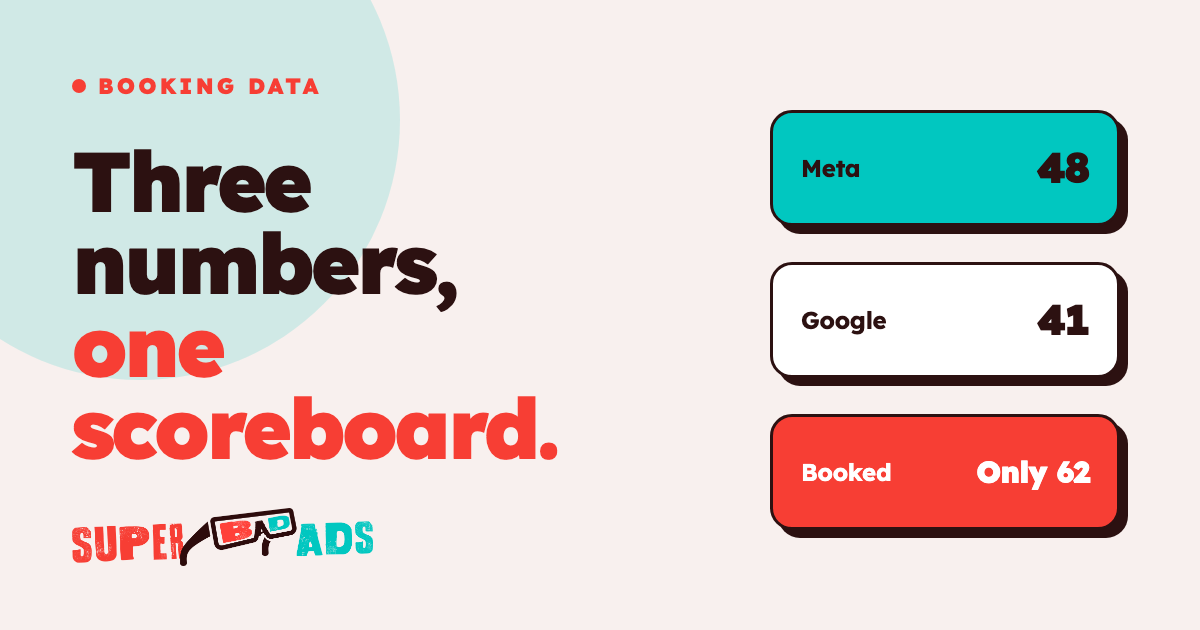
Read every test in booked first-time clients per location, counted in your booking system, next to the spend on each ad. Click rate and cost per click tell you which ad drew attention; booked first-time clients tell you which ad filled a chair, a class or a treatment room. The platform's reported conversions are usually higher than the booking system's count, so we report the stricter number. Our post on why your booking system and ad platform disagree explains the gap.
Keep a one-row plan for every test, so the owner or the CFO can read it without a meeting:
| Hypothesis | Variable | Control | Variants | Test locations | Window | Read | Decision |
|---|---|---|---|---|---|---|---|
| A stylist video books more first-time clients than the static offer | Format | Current static offer image | 3 phone videos, same offer | 2 to 3 representative locations | Set before launch; covers full weeks | Booked first-time clients per location, from the booking system | Winner replaces the control; loser goes in the log |
When do you call a winner?
Call the winner only when the test window you set before launch has closed. Meta's own advice is to "wait until Meta delivers your final test results before assuming a winner." Early numbers swing, and an ad that looks cheap on day three often books fewer first-time clients by the end. We set windows that cover whole weeks, because weekday and weekend bookings differ at most locations.
When the window closes, compare booked first-time clients per location and cost per new client for each ad, since ad performance on clicks alone can point to the wrong winner. If two ads finish close, the cheaper one to produce wins, because it's the one you can remake for every location. If no variant beats the control, the control stays and the hypothesis is logged as a loss, which still tells the team which messaging angle not to fund again.
How do you roll a winner out to the other locations?
Roll a winner out in steps, not to every location on the same day. Remake the winning idea for each location with that location's staff, neighborhood and name, then add it to each location's ads and watch booked first-time clients per location for the next few weeks. When bookings from a top-performing ad fall for several weeks in a row, creative fatigue has set in, and the right move is to retire it and replace it with the next winner from the test log, so the team can run the test cycle again without a gap.
Keep a written test log: hypothesis, variable, dates, locations, result and decision. Google's guidance puts it simply: "Learn what works for you, and keep track of the findings." The log stops your team from re-testing old losers, and it's the record that shows the owner what each month of testing produced.
Where to start
Super Bad Ads is the paid media partner for multi-location grooming, fitness and wellness operators. We run Meta and Google for every location, test cheap, representative creative as many small bets, and report booked first-time clients per location every week, counted in your booking system, not in the ad platform. See how we work as a paid media agency; salon and grooming brands can also read about our work as a salon marketing agency.
For a 30+ location grooming brand, cost per new client fell 34.3% against a static-only baseline, with a 21x return on creative production. For your group, start this week: write one hypothesis, make three phone videos and run them against your current ad at two or three test locations.
FAQ
How many ads should be in one creative test?
A creative test should usually hold one control ad and three to five variants. The control is your current best ad, and each variant carries the same hypothesis in a slightly different way. More ads than that spreads a local budget too thin for any ad to book enough first-time clients to count.
How long should a creative test run?
A creative test should run for a window set before launch, long enough to cover full weeks so that weekday and weekend bookings are both counted. Stopping a test early because one ad has a cheaper click usually picks the wrong winner, so the decision should wait until the window closes and rest on booked first-time clients per location.
Do you need a professional video shoot to test ad creative?
A professional shoot is not required to test ad creative. Phone videos and photos made inside your own locations, with your own staff, often show the real experience better than a polished shoot, and they cost little enough that a team can run tests on several ideas each month and spend on production only after an idea has won.
How do you test ad creative across multiple locations?
Test ad creative at two or three representative locations rather than the whole group. Read the result in booked first-time clients per location from your booking system, then remake the winner for each remaining location with local staff and names, and roll it out in steps.
Test small, read bookings
Creative testing for a multi-location operator comes down to one hypothesis at a time, cheap representative ads, a few test locations and one scoreboard in booked first-time clients. For help running creative testing for every location, with results counted in your booking system, Get Started.
Find out what your ad spend actually books.
We instrument the whole funnel — lead to booked to showed to revenue — and buy media against the number that matters. No calendar invites, no sales-call bait. Just the build.
Get Started →