
Gym Marketing Budget: How to Set Spend Per Club
How much should a gym spend on marketing? For a multi-club group, the answer comes from each club's joins target and an allowable cost per new member, not a share of revenue. Here is how to set the budget per club and when to spend more, hold or cut.
A gym should spend whatever it takes to acquire the new members each club requires, at a cost per new member the business can sustain. For an operator with several clubs, that principle means setting the marketing budget club by club from the membership system, rather than as a single share of revenue, and reviewing each allocation monthly against joins per club per week.
That's the most defensible answer to how much should a gym spend on marketing, because the board can verify it against the membership records. Most published guidance addresses a single facility and recommends a percentage of revenue. An owner responsible for eight or thirty clubs needs a figure that reflects each club's capacity, attrition and opening schedule, plus a scoreboard that demonstrates whether the investment produced new members.
Why doesn't a percentage of revenue work for a multi-club group?
Percentage-of-revenue rules circulate widely across the fitness industry, and finance teams favor them because they produce tidy forecasts. For a multi-club operator, however, they're an imprecise instrument. A fixed percentage disregards open capacity, ignores the number of members each club loses every month, and overlooks the additional demand a new club must generate before its opening.
A single blended figure also conceals the difference between your strongest and weakest locations. Mature clubs with waitlisted classes generate the most revenue, so a uniform rule assigns them the largest share of the gym marketing budget. Newer clubs generate less revenue but depend most heavily on local demand, so the identical rule allocates them the least. Consequently, full clubs are overfunded while clubs with available capacity are underfunded.
Advertising for a club already operating at capacity produces frustrated prospects rather than members. A percentage also tells the board nothing about the cost of acquiring a member at any individual club, so your marketing strategies need a method that funds each location according to the members it can genuinely accommodate.
How do you set a gym marketing budget per club?
Construct the budget from the bottom up, one club at a time. The method relies on three inputs, and every one of them comes from your own systems rather than from an industry benchmark.
- New members required: Begin with the members each club loses in a typical month, because you must replace them simply to remain level. Add the growth target for that club, limited by the open capacity on the floor and in classes. A club approaching capacity requires replacement only, whereas a club with room to grow receives a higher target.
- Allowable cost per new member: Calculate this figure from a member's value across a typical membership and from your operating margin. It represents the maximum you can pay to acquire a member while still earning a return, much like a cost per acquisition (CPA) ceiling. Your finance lead can establish it once per club type and revisit it quarterly.
- The budget: Multiply the new members required by the allowable cost per new member. The result is the club's monthly gym advertising budget, and its purpose is transparent to the board.
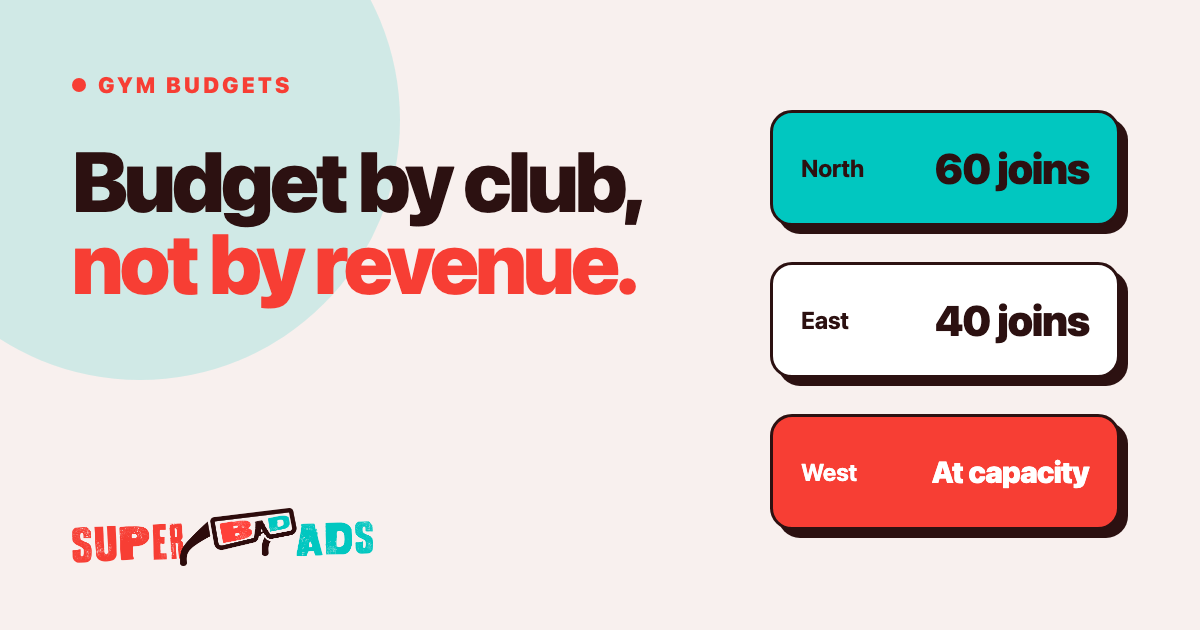
Consider an illustration expressed in member counts alone. One club loses roughly 40 members in a typical month and has capacity for 20 more, so its target is 60 joins. A second club loses a similar number but operates near capacity, so its target is 40. Even with comparable revenue, the first club requires half again as much spend as the second.
The method also exposes retention problems that a percentage conceals. When members cancel quickly, their value declines, and so does the allowable cost per new member; additional spending merely refills a leaking bucket, so address retention first and hold the budget steady.
Where should the money go?
Most of the budget belongs in local digital advertising around each club. Social media ads on Meta, managed in Ads Manager and aimed at the area surrounding a club, create demand among people who aren't searching yet, while Google Ads reach people who are already looking for a gym nearby. Each club receives its own campaigns and its own line in the report, so advertising costs remain visible location by location.
Creative is the second decision, and many owners remind us that they aren't Nike. You don't need an expensive production to fill classes; cost-effective, representative creative consistently performs better for marketing for gyms. Authentic photographs of classes, short clips of coaches and plain copy that states the intro offer are sufficient for building brand awareness in a local community. Test numerous small ideas across clubs and extend the winners. Our guide to fitness studio marketing describes that testing approach in more detail.
Responsive follow-up should precede any increase in spend. When the front desk takes hours to answer an inquiry, prospects book elsewhere, and no budget increase compensates for that delay. Measure how quickly each club responds and what share of inquiries become booked visits before allocating additional money. Our guide on how to get more gym members explains the sequence of those steps, including email campaigns to existing members and community events.
Finally, reserve a portion of the fitness marketing budget for new clubs. A new club requires a presale campaign that recruits founding members before the doors open, so plan its spend against the opening date rather than its current revenue. The per-club discipline described in our guide to multi-location marketing applies equally to traditional marketing and digital marketing efforts.
When should you spend more, hold or cut?
Once the budget is established, manage it with a small set of key metrics drawn from the membership system rather than from the advertising platforms.
- Increase spend: The club's cost per new member is below the allowable cost, it has open capacity, and the front desk is converting inquiries into booked visits.
- Hold spend: The booked percentage is declining. That pattern usually indicates slower follow-up, and additional spend would only raise the cost per new member.
- Reduce or reallocate spend: The club is approaching capacity, or its cost per new member remains above the allowable cost for several weeks. Redirect that money to a club with room to grow or an upcoming opening.
Your reporting should be stricter than the platform numbers. Advertising platforms count anyone who clicked or viewed an ad, so their figures consistently look more favorable than your recorded joins. To demonstrate that spend is incremental, compare clubs or periods at flat spend and examine the change in new members per club per week. That standard is one a board can trust.
As examples of what this discipline makes visible, a multi-location gym operator that switched agencies improved from a 0.15x to a 1.62x paid-search return by month three on flat spend. An eight-location California fitness operator progressed from 0 of 8 to 8 of 8 locations with per-location attribution and reduced its cost per lead by 25% by month three.
Where to start
Super Bad Ads is the paid media agency for multi-club gym and fitness groups. We run Meta and Google around every club, test many low-cost creative ideas instead of one expensive shoot, and report new members per club every week from your membership system.
If you're determining how much should a gym spend on marketing for the next budget cycle, begin with the scoreboard. Establish joins per club per week and cost per new member before changing any spend, and agree on the allowable cost per new member with your finance lead. As a gym marketing agency, we audit your current campaigns before you switch, so you retain what's already working. Our multi-location marketing agency services are designed for lean marketing teams that report to an owner or a board.
Frequently asked questions
How do I calculate cost per new member?
Divide a club's paid media spend for a period by the joins your membership system recorded for that club during the same period. Track it weekly and compare it with the allowable cost per new member.
How much do gyms spend on marketing?
Published figures vary considerably, and most originate from vendors writing for single facilities. For a multi-club group, the more useful question is how many new members each club requires and what you can afford to pay for each one. That approach produces a defensible budget per club that you can adjust monthly.
Why don't my ad platform numbers match my membership system?
Advertising platforms claim credit for anyone who viewed or clicked an ad, even when that person never joined. Your membership system records actual joins, so rely on it and report the stricter number.
How should we budget for a new club presale?
Start from the founding members the club requires by opening day and the cost per new member you anticipate. Plan that spend backward from the opening date, and track presale joins weekly so you can adjust the allocation before the doors open.
Conclusion
The answer to how much should a gym spend on marketing isn't a percentage; it's a per-club figure derived from the joins each club requires and the cost per new member you can sustain. Build the scoreboard first, fund clubs according to capacity and opening dates, and allow joins per club per week to determine where the next dollar goes. When you're ready for a partner to manage it with you, Get Started.
Find out what your ad spend actually books.
We instrument the whole funnel — lead to booked to showed to revenue — and buy media against the number that matters. No calendar invites, no sales-call bait. Just the build.
Get Started →